
Free kit
Fishbone Diagram Guide: Cause-and-Effect (Ishikawa) Root Cause Analysis
A 47-slide guide to the fishbone diagram: what it is, how to build one, the cause categories to use and how to run the analysis with a team.
A step-by-step slide guide to the fishbone diagram, also called the cause-and-effect or Ishikawa diagram: an organised way to uncover and group the possible causes of a problem. It builds the diagram up one piece at a time, with worked examples.
What is inside
Overview — what the diagram shows, where its name comes from, what it is good for and its benefits.
Building the diagram — the effect as the head, the spine, the category bones and the causes, and using the 5 Whys to get past symptoms.
Categories — the 4 Ms and 6 Ms and other ways to group causes, alternative names for the same category, and adding subcategories as new branches.
How to conduct a fishbone analysis — the steps to run it with a team.
Further information — common mistakes, such as listing a solution in disguise as a cause, and worked examples.
One PDF in widescreen slide format.
Who it is for
Quality, HSE and operations staff, supervisors and team leaders who investigate problems, complaints, defects or incidents, and anyone preparing a corrective action who needs to show how the root cause was found.
How to use it
Read it through once, then run a session with the people who know the process: agree the effect, pick the categories, collect causes on the bones and ask why until you reach causes you can act on. Present the slides to a team before its first session so everyone uses the tool the same way.
This is general training material. A fishbone diagram organises possible causes; confirm the real cause with evidence before you act on it.
What is in the kit
- Fishbone Diagram Guide (PDF)47 slides: overview, building the diagram, cause categories (4 Ms, 6 Ms), how to conduct the analysis, and common mistakes.493 KB
A look inside
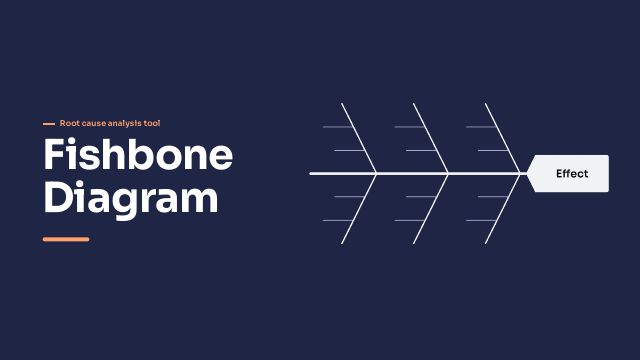
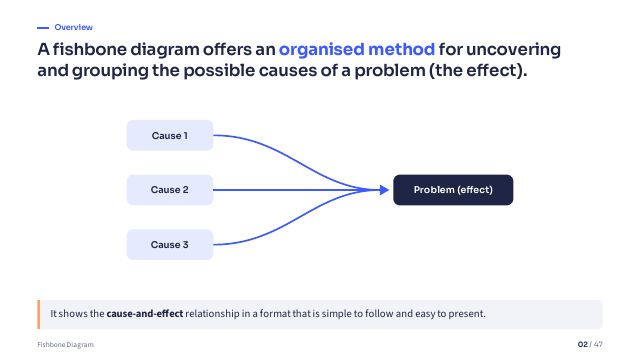
The first pages of Fishbone Diagram Guide (PDF). The full document downloads from the list above.
Questions people ask
Is the Fishbone Diagram Guide: Cause-and-Effect (Ishikawa) Root Cause Analysis really free?
Yes. There is no payment and no trial. Tell us your name, work email and company once, and every document in the Free Zone is yours to download.
What format are the documents in?
This kit has 1 document in PDF format.
Can I use it inside my company?
Yes. The licence covers one organisation with unlimited internal use — print it, share it with colleagues and adapt it. Please do not resell it or republish it as your own.
Does this make us compliant with Root Cause Analysis?
No document can do that on its own. It is a practical working tool to help you prepare, check and improve. Conformity with Root Cause Analysis is decided by an audit of your actual system, and the standard itself remains the authoritative text.
Do you offer training on this topic?
Yes. Skedmia runs online courses with certificates on the standards and topics these kits cover — the matching courses are listed on this page.
More from the Free Zone
 FreeNew
Fire-Sprinkler-Systems
A practical programme for fire marshals, fire department personnel, safety managers & facility operations leaders, building the knowledge to understand, inspect, and restore fire sprinkler systems.
 FreeNew
Environmental - Audit
A practical module for environmental, safety and operations professionals, covering how to plan, carry out and follow up environmental audits with confidence.
 FreeNew
Food Safety Signs and Posters: Bilingual Hygiene, Temperature, Storage, Allergen & Safety Signage Kit
Hygiene, temperature, storage, allergens, hazards and workplace signs, in English and Arabic.