
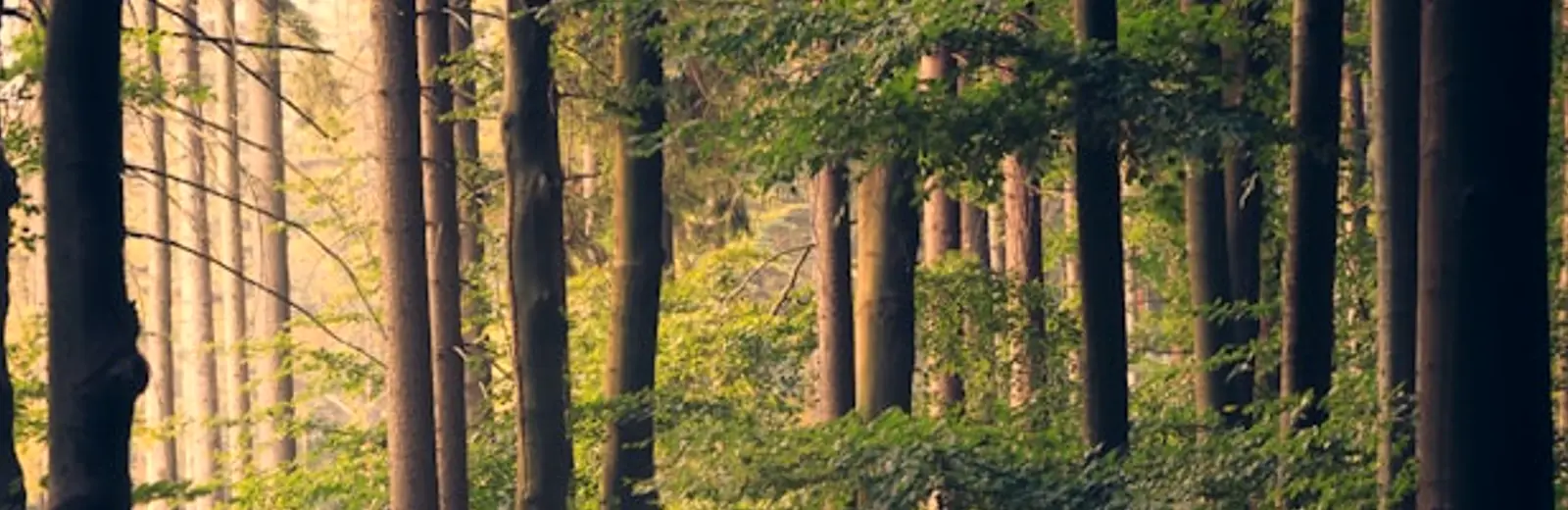
Environment and Ecology Systems
Understand how ecosystems work - biodiversity, energy, nutrients, populations, landscapes - and apply that science to real environmental decisions.
21
Lessons
~8h
Study time
30
Exam questions
Earns a QR-verifiable Certificate of Training
Overview
About this course
Environment and Ecology Systems is a complete grounding in the science that underpins environmental practice. It takes you from the physical drivers that set where life can live, through the measurement of biodiversity, the flow of energy and the cycling of nutrients, to the dynamics of populations, communities, landscapes and the whole biosphere - and then into the human side: resource use, ethics, policy and law, conservation management and environmental impact assessment.
The course is written for people who need to use ecology, not only admire it. Every lesson carries real methods and real numbers: how primary production is measured and what it amounts to biome by biome, how diversity indices are calculated and where they mislead, how the IUCN Red List criteria are structured, how mark-recapture estimates are produced and corrected, how edge effects erode the usable core of a habitat patch, and how impact assessment turns ecological baseline data into a defensible mitigation hierarchy.
Throughout, the emphasis is on systems thinking: pools and fluxes, feedbacks and time lags, thresholds and resilience. By the end you should be able to look at a site, a catchment or a policy proposal and say what is actually being changed, what evidence would show it, and what could be done about it.
What you will learn
- How ecological systems are organised, from organism to biosphere, and how scale changes the question you can answer
- How to quantify biodiversity using richness, Shannon and Simpson indices, rarefaction and species-area relationships - and how to read IUCN Red List assessments
- How energy enters and moves through ecosystems, and how to work with gross and net primary production, trophic efficiency and ecological pyramids
- How carbon, nitrogen, phosphorus and sulphur cycle, how decomposition and soils regulate nutrient retention, and where human activity has overloaded these cycles
- How populations grow, are regulated and are estimated, including logistic growth, life tables, mark-recapture and minimum viable population thinking
- How species interactions build community structure, and how succession, disturbance and resilience govern change over time
- How landscape structure, fragmentation, edge effects and connectivity determine what survives in a modified world
- How environmental ethics, policy, law, conservation management and impact assessment turn ecological understanding into practice
Who it is for
The course suits environmental officers, HSE and sustainability professionals, EIA and ESIA practitioners, planners, engineers and consultants who need ecological literacy for their day job; conservation and protected-area staff; teachers and students of environmental science; and anyone moving into an environmental role from another discipline who needs the scientific foundation quickly and rigorously. No prior degree in biology is assumed - the mathematics used is arithmetic and simple algebra, worked through step by step.
How the course works
Study is entirely online and self-paced, so you can work through the modules in whatever blocks of time suit you and return to any lesson as often as you like. Expect around six to eight hours of study in total. The course concludes with a 30-question final exam with a pass mark of 70%; on passing you receive a verifiable SKEDMIA certificate of completion.
What you earn
A certificate anyone can verify in seconds
Score 70% or better on the final exam and Skedmia issues your Certificate of Training with a unique certificate number. Every certificate carries a QR code that resolves to our public register, so an employer or auditor can confirm it is genuine without contacting anyone.
Verified at skedmia.com/verify
Certified by
Syllabus
Course content
8 modules · 21 lessons · ~8h
01Module 1 — Foundations - Ecology, the Environment and Scale2 lessons
- What Ecology Studies: Levels of Organisation, Scale and MethodPreview20 min
- The Physical Environment: Climate, Biomes and Limiting Factors20 min
02Module 2 — Biodiversity, Function and Energy3 lessons
- Measuring Biodiversity: Richness, Diversity Indices and Threat Status22 min
- Biodiversity and Ecosystem Functioning20 min
- Energy Flow: Primary Production, Trophic Efficiency and Food Webs22 min
03Module 3 — Nutrient Cycles and Population Processes3 lessons
- Biogeochemical Cycles: Carbon, Nitrogen, Phosphorus and Sulphur22 min
- Decomposition, Soils and Nutrient Retention20 min
- Population Dynamics and Regulation22 min
04Module 4 — Communities, Succession and Landscapes3 lessons
- Species Interactions and Community Structure22 min
- Succession, Disturbance and Resilience20 min
- Landscape Ecology and Ecosystem-Scale Analysis20 min
05Module 5 — Global Environmental Change2 lessons
- Climate Change — Drivers, Evidence and Ecological Response25 min
- Ozone, Acidification, Nutrient Loading and Novel Entities25 min
06Module 6 — Human Population, Resource Use and Sustainability3 lessons
- Human Population Dynamics and the Demographic Transition20 min
- Resource Use, Ecological Footprint and the Circular Economy25 min
- Environmental Ethics, Planetary Boundaries and Sustainability20 min
07Module 7 — Environmental Policy, Law and Governance2 lessons
- International Environmental Law and Multilateral Agreements25 min
- National Regulation, Permitting and Economic Instruments25 min
08Module 8 — Management, Assessment and Conservation in Practice3 lessons
- Environmental Management and Conservation Planning25 min
- Environmental Impact Assessment and the Mitigation Hierarchy30 min
- Case Studies in Environmental and Ecological Issues20 min
Keep browsing
More environment & energy training
 TrendingNew
ISO 14001 (Environmental Management Systems)
ISO 14001:2026 Lead Auditor Transition Training
 New
NewEnvironmental Management
Environmental Sustainability Awareness — Whole-Workforce Course with Certificate
 New
NewSustainability & Climate